Basement & Foundation Waterproofing in Cape Town
Cape Town basement and foundation waterproofing — interior cementitious tanking, crystalline systems (Xypex, Penetron), cavity drain membranes and sump-and-pump installations for cellars, converted garages and cliff-side retaining walls.
Benefits
Interior-only solutions when exterior excavation is not practical — the reality on 95% of existing Cape Town homes
Crystalline integral systems (Xypex, Penetron, Krystol) that grow self-sealing crystals into existing concrete
Cavity drain membrane + sump installations (Delta MS, Newton CDM) where the slab cannot be raised
Free inspection with moisture mapping and water-source diagnosis
10-year workmanship guarantee backed by manufacturer warranties of up to 25 years on crystalline systems
Structural engineer sign-off available on retaining walls and habitable basement conversions
Our Process
Site inspection — we map moisture readings room by room, check for chloride salts, and trace the water source
Identify whether the problem is groundwater, lateral seepage from the slope, broken stormwater, or condensation masquerading as damp
Specify the right system — crystalline for sound concrete, cementitious tanking for masonry, cavity drain membrane where water has to be managed not blocked
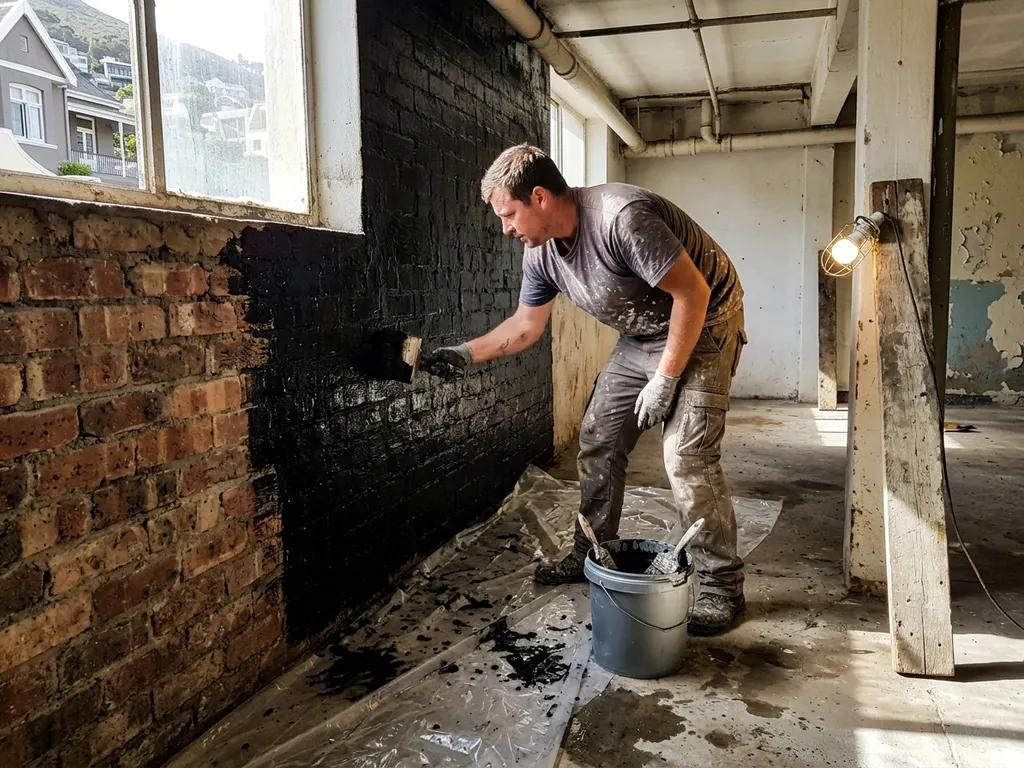
Prep the substrate — hack off all loose plaster back to original masonry or concrete, profile the surface, treat construction joints with hydrophilic strips
Install the chosen system per the manufacturer's spec sheet — usually two to three coats with a 24-hour cure between applications
Where a cavity drain membrane is used, lay a perimeter channel into the floor, connect to a twin-pump sump with battery backup, and discharge to stormwater
Reinstate finishes, walk you through the system, and issue the 10-year guarantee plus engineer's certificate where required
Pricing
From R380/m²
2026 Cape Town pricing. Cementitious tanking R380-R650/m². Crystalline integral systems R450-R800/m². Bentonite membrane (excavated installations) R550-R950/m². Cavity drain membrane systems R600-R1,100/m² including sump and pump. French drains R450-R900 per linear metre. Engineer fees and any excavation, shoring or scaffolding quoted separately.
Get Accurate QuoteFrequently Asked Questions
When is interior cementitious tanking enough on its own?
It is enough when the hydrostatic pressure is moderate, the substrate is sound masonry or concrete, and we can hack back to a clean profile that the tanking will bond to. A Wynberg basement storeroom with intermittent winter damp through a single wall is a textbook case — three coats of Sika 1 or Drizoro Maxseal Foundation on a properly prepared substrate will hold for fifteen to twenty years. The minute the wall is structurally cracked, the pressure is high enough to spall the coating, or there is visible standing water during winter, tanking alone is the wrong call and we move to a managed-water solution.
When do you need a cavity drain membrane plus a pump instead?
When the floor cannot be raised, the water table is genuinely above the slab, or the building has live structural movement. We see this constantly in Green Point and Sea Point converted-basement garages where the original 1960s construction sits below the modern water table — there is no realistic way to block that volume of water, so we install Delta MS or Newton CDM membrane on the walls and floor, lay a perimeter drainage channel, and pipe everything to a twin-pump sump with battery backup. The space stays dry, the water is managed, and any future seepage simply runs into the channel instead of into your finishes.
I have seepage on a Bantry Bay cliff-side retaining wall — what do I do?
Cliff-side retaining walls in Bantry Bay almost always need a two-part fix. First, on the inside face, we apply a crystalline system like Xypex Concentrate so the concrete itself becomes waterproof and any new hairline cracks self-seal with future moisture exposure. Second, we install a horizontal weep system and a vertical drainage layer behind the wall where access permits — usually possible on the upper terrace, rarely possible against the slope. Where the slope side cannot be reached, we accept that we are managing rather than blocking the water and add a discreet perimeter channel at the wall base to catch anything that finds a path through.
Why is exterior excavation so rarely the answer on an existing home?
Because the cost-benefit collapses the moment you account for landscaping, paving, boundary walls, neighbour interfaces, and the risk of undermining the existing footing during the dig. On a Constantia valley cellar with mature gardens above it, exterior excavation might mean tearing out a R200,000 landscaping scheme to install a R60,000 membrane — and you still need engineering input to shore the excavation safely. We reserve positive-side exterior work for new builds, full structural basement conversions where the slab is being recut anyway, or the rare case where a single accessible elevation has failed and the rest of the house is fine.
How does a crystalline system like Xypex or Penetron actually work?
Crystalline products are cement-based slurries (or concrete admixtures, for new pours) that contain reactive chemicals which migrate into the capillary network of the concrete, react with calcium hydroxide and moisture, and grow insoluble crystals deep inside the pore structure. Those crystals physically block water passage but allow water vapour to pass, so the concrete still breathes. The reaction is dormant until moisture appears, then reactivates — which means hairline cracks up to about 0.4mm self-heal over time as new water arrives. It is the only system we use that becomes part of the concrete rather than sitting as a coating on top of it, which is why it tends to last the life of the structure.
What about a Constantia cellar with garden-level damp — can it be fixed without disturbing the garden?
Yes, almost always. The standard solution for a Constantia valley garden-level cellar is interior cementitious tanking on the affected walls, plus a discreet perimeter french drain installed inside the cellar at the wall-floor junction to relieve hydrostatic pressure. Where the cellar has a finished floor we want to preserve, we substitute a cavity drain membrane and sump to keep the existing floor intact. The garden above stays untouched. Done correctly with the right substrate prep and a proper drainage discharge, this lasts fifteen to twenty years without recoating.
How long does this work actually last?
Crystalline systems last for the life of the concrete because they are integral to the matrix, not a surface coating. Cavity drain membranes carry 25 to 30-year manufacturer warranties when paired with serviced sump pumps. Cementitious tanking realistically gives you 15 to 20 years before any recoating is needed. Bentonite membranes installed externally last 25+ years when correctly backfilled. We back every installation with our 10-year workmanship guarantee, and on habitable basement conversions we provide engineer-signed certification for council sign-off and insurance purposes.
Basement & Foundation Waterproofing across Cape Town
We cover the suburbs below — free on-site inspection on every quote:
Ready to Get Started?
Get a free, no-obligation basement & foundation waterproofing quote from our Cape Town team — on-site inspection included.
Get Free Quote Now